
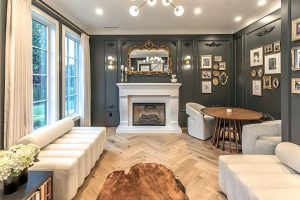
A home that feels finished and well built usually isn’t about expensive furniture. It’s about the details you pass every day: the doors, the trim around them and the hardware in your hand. Get those right, and even a modest home starts to feel more considered.
The good news? Most of these upgrades are very attainable. Here are nine that make the biggest difference.
1. Make your doors look taller with better casings
Many homes come with thin, flat builder casing around the doors. Swapping it for a wider casing instantly gives each doorway more presence.
To make doors look even taller, add an architrave moulding: a thicker piece placed across the top of the door casing, sometimes finished with a small cap or crown detail. It draws the eye up and makes ceilings feel higher too.
If you’re renovating or building, consider taller doors. An 8-foot door in a room with 9-foot ceilings looks far more proportional than a standard-height one.
2. Go taller with your baseboards
Short baseboards can make a room feel unfinished. A taller baseboard grounds the walls and makes the whole space feel more substantial. As a general rule, the higher the ceiling, the taller the baseboard should be.
Not sure what size fits your rooms? Our moulding size guide in the Resources section walks you through it.
3. Coordinate your trim
Mismatched trim is one of the quickest ways to make a home feel pieced together. Choose one profile family for your casings, baseboards and any crown, and use it throughout.
Paint your trim and doors in the same colour and sheen, too. That consistency reads as intentional and well designed.
Try the monochrome look. Contrasting white trim against coloured walls is giving way to something more layered. Many homeowners now paint the walls, baseboards, casings and wall panelling all in one colour.
Without colour breaking things up, the eye notices texture instead: the shadow lines of a casing profile, the depth of panel moulding, the rhythm of board and batten. The result feels rich, calm and custom. For a subtle bit of definition, and easier cleaning, use the same colour on trim in a slightly higher sheen than the walls.
4. Upgrade to solid-core doors
You feel the difference the first time you close one. Solid-core doors are heavier, block more sound and shut with a satisfying, solid feel. Paired with a clean shaker or panel style, they make every room feel better built.
5. Choose better hardware and match the details
Hardware is something you touch every day, so quality shows. A well-weighted lever or knob feels more solid in the hand.
The detail most people miss is the hinges. Match your hinges and door stops to your handle finish. Brushed brass handles on silver hinges stand out for the wrong reasons. One finish, carried through the whole home, looks polished.
Contrast is another easy win. A hardware finish that stands out against the door draws the eye and highlights the door and trim around it. A few pairings that work well:
- White doors with brass or golden brass for a warm, elevated look.
- White doors with matte black for a crisp, modern feel.
- Wood doors with satin nickel or matte black to let the grain shine.
- Dark or black doors with brass for a bold front entry.
The key is to contrast the hardware with the door, while keeping the hardware finish consistent from room to room.
6. Add a feature wall
Wall panelling turns a plain wall into a focal point. Popular options include:
- Panel moulding: Picture-frame boxes for a classic, tailored look.
- Wainscoting: Panels on the lower part of the wall, great for dining rooms and hallways.
- Board and batten: Clean vertical lines that suit modern farmhouse and transitional homes.
- Shiplap: Relaxed horizontal boards for a coastal or casual feel.
Great spots to try it: the front entry, dining room, stairway or behind the bed.
7. Make a statement with a barn door
A barn door turns an ordinary opening into a design feature. Today’s hardware also goes well beyond the rustic look many people picture.
- Ghost track hardware: The track is hidden above the door, so the door seems to float as it slides. It’s a clean, modern look that suits contemporary and transitional homes.
- Bifold barn door hardware: The door is split into two panels that fold as they slide. It needs less wall space beside the opening, which makes it a smart choice for tight spots and closets.
Barn doors work beautifully on pantries, laundry rooms, home offices and closets. Keep in mind they don’t seal like a standard door, so they’re less suited to rooms where privacy or sound matters most. For a polished finish, match the hardware to the rest of your home’s finishes.
8. Open up to the outdoors with glass doors
Few upgrades change how a home feels like natural light. Large glass doors fill a room with daylight and frame the greenery and views outside, so the garden or patio becomes part of the room.
- Folding door systems: Multiple glass panels fold neatly to one side, opening almost the entire wall. Inside and outside blend into one space, perfect for summer gatherings and entertaining.
- Large glass patio doors: Even without folding, oversized sliding or swing patio doors make a dramatic difference. They bring in light all year and keep the view in sight on rainy West Coast days.
This is a larger project than swapping trim or hardware, but it’s one of the most transformative. Our team can help you compare sizes, configurations and performance options for your opening.
9. Other small upgrades that add up
- Crown moulding softens the line where walls meet the ceiling and makes rooms feel complete.
- French doors or doors with glass lites bring in light and add a sense of openness between rooms.
- A refreshed front door makes a strong first impression. Even new hardware or a bold paint colour can change how your home is seen from the street.
- Bifold to French or bypass doors on closets can make a bedroom feel more custom.
Where to start
You don’t have to do it all at once. If you’re working room by room, start where people spend the most time or form a first impression:
- Front entry: door, hardware and a feature wall.
- Main living areas: casings, baseboards and coordinated trim.
- Bedrooms and bathrooms: solid-core doors and upgraded hardware.
Small, consistent upgrades in the right places often make more impact than one big project.
See it all together in our showroom
It’s much easier to picture the finished look when you can see doors, mouldings and hardware side by side. Visit our Surrey showroom to compare casings, baseboards, panelling, doors and hardware finishes in one place.
Planning a refresh? Email us at info@a1doors.ca and our team will help you choose the pieces that work together.